Pillows · Positioning · Everyday care
Seating Support or Bed Rest? Choosing Pillows for Better Positioning
A pillow can change the angle of a shoulder, steady a tired back, or make a quiet hour of reading more comfortable. But support that works for sitting may not suit sleep or recovery. Understanding the difference between seating support and bed-rest pillows helps caregivers choose with purpose—and recognize when a clinician’s guidance is needed.
Published November 17, 2026
Positioning begins with a simple question: what is the body being asked to do? Sitting upright to eat, read, or talk calls for a different kind of support than reclining to rest. The distinction can seem subtle when looking at a cushion on a bed, yet the effects are practical. A pillow placed behind the back may help someone remain comfortably upright; the same pillow may be awkward or unstable when they are trying to sleep.
In a hospital room, a care facility, or a home bedroom, positioning is shaped by more than the pillow itself. The mattress, bed frame, the person’s mobility, the length of time spent in one position, and the help available all matter. The aim is not to force the body into a perfect posture. It is to provide suitable, steady support for the activity at hand, while preserving comfort and safety.
Start with the activity, not the shape
Pillows are often grouped by their appearance: wedge, bolster, backrest, or bed pillow. Those labels can be useful, but they do not tell the whole story. A more reliable starting point is the task. Is the person sitting for a meal? Reclining to rest? Reading for a short time? Recovering under a clinician’s positioning plan? Each situation places different demands on the torso, shoulders, neck, and arms.
Seating support is intended to help maintain an upright or semi-upright position. A backrest pillow, for example, may provide a broad surface behind the torso and lumbar area, helping someone sit on a bed without relying entirely on a headboard or a stack of loose pillows. This can be useful for ordinary activities such as reading or working on a laptop. It is not, by itself, a substitute for an adjustable bed or a prescribed positioning device.
Bed-rest pillows have a wider range of uses. A standard bed pillow may cushion the head, while a smaller pillow can support an arm or fill a modest gap. Wedges and other shaped cushions may help maintain a particular resting angle. Because the word “rest” can include anything from a brief recline to overnight sleep, it is important to match the support to the specific position and follow any care instructions provided by a health professional.
What good seating support feels like
A supportive seat does not need to feel rigid. It should offer enough stability to reduce the effort of holding the torso upright, without pushing the person forward or tipping them sideways. The back should meet the support in a comfortable way, and the head and shoulders should be able to settle naturally rather than being forced into a fixed angle.
Pay attention to the lower back. If a pillow leaves a large gap behind the waist, the person may slump or compensate by tightening their muscles. If it is too bulky, it may push the torso forward and make the position feel cramped. A useful pillow supports rather than dictates: it helps the body find a comfortable arrangement, while leaving room for small adjustments.
The base matters, too. A pillow resting on a mattress may shift as someone leans back, reaches for a bedside table, or changes position. Check that the cushion stays where intended and that the person can get on and off the bed safely. For anyone with limited balance or mobility, a soft pillow should not be treated as a safety rail or transfer aid. Those needs call for appropriate equipment and professional assessment.
Bed rest is not one position
Resting can mean lying flat, reclining with the torso raised, or settling on one side. A pillow suited to one of these positions may not work for another. A tall backrest designed for sitting, for instance, may be too large or too firm for comfortable side sleeping. A soft bed pillow can feel pleasant under the head but may compress too much to provide dependable support behind the torso.
When reclining, consider the line from the head through the shoulders and back. The support should not create an abrupt bend at the neck or leave the shoulders hanging forward. If the legs are also being supported, avoid building an unstable pile of cushions that can slide apart. Small, deliberate adjustments are often easier to assess than a complicated arrangement of several pillows.
People who have a medical condition, recent surgery, breathing difficulty, pain, or restrictions on movement may need a specific position. In these cases, general pillow advice is not a care plan. Ask a nurse, physician, physical therapist, or occupational therapist which positions are appropriate, how long they should be maintained, and what signs mean the arrangement needs to change.
Five details to assess before choosing
- Stability: Does the pillow remain in place during ordinary movement, or slide, collapse, or tip? A support that repeatedly shifts can become frustrating and may compromise a comfortable position.
- Adjustability: Can the user change their posture without wrestling with the cushion? Some people need a support that allows brief shifts throughout the day rather than holding them at one fixed angle.
- Body alignment: Does the support meet the back and shoulders without forcing the head, neck, or pelvis into an uncomfortable position? Check how the whole posture feels, not just the point where the pillow touches.
- Ease of cleaning: A removable, washable cover can make routine care simpler. Follow the manufacturer’s cleaning instructions and allow the cover and filling to dry fully before use.
- Fit and setting: Consider the bed’s width, the user’s size, available space, and whether a caregiver needs access. A large pillow may offer generous support but make transfers or bedside care more difficult.
Stability, adjustability, and comfort
Comfort is more than softness. A pillow that feels plush at first may compress quickly and provide little lasting support. A firmer cushion may keep its shape but feel uncomfortable if its edges press into the body. The right balance depends on the person, the activity, and the length of use. When possible, test a support in the actual setting and for the task it is meant to serve.
Adjustability can be especially valuable during everyday care. Someone may sit upright for a meal and then recline to rest. A support that can be repositioned without complicated handling may make these transitions easier. However, adjustment should not come at the expense of stability. If the cushion is difficult to set up securely, or requires lifting that could strain a caregiver, consider a different design or seek advice about appropriate equipment.
Materials and construction also affect everyday use. Breathable fabric may feel more comfortable during extended contact, while a removable cover can simplify laundering. Look at seams, closures, and care labels, particularly where the pillow will be used frequently. In settings with infection-control requirements, follow facility procedures rather than assuming a household washing method is sufficient.
A backrest pillow for upright activities
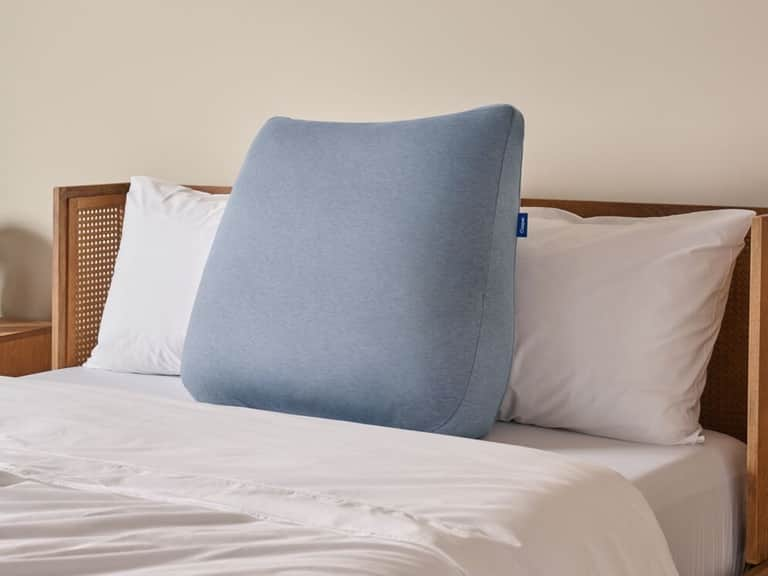
A backrest pillow is one option for short periods of sitting or reclining on a bed. Its raised profile can provide support behind the upper body, and a shaped design may offer additional contact around the lower back. For example, the Backrest Pillow has a teardrop shape intended to support posture and lumbar comfort while sitting or lying down. Its cover is removable and machine washable; the listed dimensions are 24 inches tall and across, and 12 inches thick at its widest point.
Dimensions are only a starting point. A pillow that is a comfortable size for one bed or body may feel oversized in another setting. Consider where it will sit, how much room remains for the user, and whether its shape supports the intended activity. A backrest pillow can be a practical convenience for reading or lounging, but it should not be assumed to provide clinical pressure relief, prevent falls, or meet a medical positioning requirement.
Caregiver checks that make a difference
Before settling someone into a supported position, clear the immediate area and make sure the bed is stable. Place the pillow where it can be reached without twisting or stretching, and ask the person whether the angle feels comfortable. If they cannot communicate easily, observe their expression, breathing, and ability to relax. A position that looks tidy is not necessarily a comfortable one.
After positioning, check whether the support has moved and whether any area is under uncomfortable pressure. Do not leave a person in a position that causes pain, numbness, difficulty breathing, or distress. If there is a care plan, use its instructions for repositioning and monitoring. A pillow is a comfort aid, not a substitute for recommended movement, skin care, or professional supervision.
Caregivers should also consider the effort involved. Repeatedly lifting or hauling a heavy cushion can strain the back and shoulders. A manageable support is more likely to be used consistently and adjusted safely. If the person needs help changing position, ask a clinician to demonstrate suitable techniques and identify whether additional equipment is appropriate.
Common positioning mistakes
- Stacking too many pillows: Multiple soft layers can shift unpredictably, leaving the torso unevenly supported. Begin with a simple arrangement and add support only when needed.
- Using a sitting pillow for overnight sleep: A backrest made for upright activities may not be designed for prolonged or overnight use. Check product instructions and choose support suited to the intended duration.
- Forcing a fixed posture: The body needs the freedom to make small adjustments. If a pillow causes the person to brace, slump, or repeatedly try to move away from it, reconsider the fit.
- Ignoring the bed surface: A cushion may behave differently on a firm mattress than on a soft or adjustable surface. Assess the complete setup rather than judging the pillow alone.
- Relying on general advice for a medical need: Pain, surgery, breathing concerns, pressure injury risk, or movement restrictions require individualized guidance from a qualified clinician.
When to ask a clinician
Seek professional guidance when positioning is part of treatment or when a person has difficulty sitting safely, repeatedly slides out of position, experiences new pain or numbness, or cannot breathe comfortably in a chosen posture. A clinician can assess mobility, comfort, equipment, and the needs of the room. They can also explain whether a pillow is suitable or whether a specialized support is needed.
People with limited sensation may not notice pressure or an awkward position right away. Caregivers should follow any skin-monitoring and repositioning instructions supplied by the care team. A cushion marketed as supportive should not be assumed to prevent pressure injuries. Product features and general comfort are not substitutes for an individualized plan.
A practical decision guide
For a brief reading session, a stable backrest pillow may be convenient if it fits the user and stays in place. For a nap or overnight sleep, choose a pillow designed for that use and avoid arrangements that restrict comfortable movement. For a person recovering from illness or injury, follow the discharge instructions and ask the care team before changing a recommended position. For regular caregiving, prioritize cleanability, manageable handling, and a setup that allows safe access to the bed.
A short trial can reveal what a product description cannot. Sit or recline in the intended position for a few minutes. Notice whether the shoulders relax, whether the lower back feels supported, and whether the pillow shifts when the user moves naturally. Reassess after the activity; a cushion that works for ten minutes may not be comfortable for an hour.
Support that serves the moment
The most useful pillow is not necessarily the most elaborate. It is the one that matches the activity, supports a comfortable alignment, remains stable, and can be cared for properly. Seating support and bed-rest pillows may share a room, but they do different jobs: one helps make upright time more comfortable, while the other supports rest in a position suited to the person and the setting.
The best choices begin with observation and a clear purpose. Consider what the person will be doing, how long they will remain there, and whether a medical plan applies. Then check fit, stability, adjustability, and cleaning needs. When positioning affects health or safety, bring a qualified clinician into the decision. A small adjustment in support can make an ordinary bedside moment more comfortable—but thoughtful care is what makes that support appropriate.